Begin your collection with 15% off your first publication — Use code: WELCOME15
What Grandma Helen Would Think
A Meditation on Trash Can Art, Junk Journals, and Who Gets to Decide
CREATIVE LIFE & MINDSET
Sandy Lowdermilk
5/13/20265 min read
I was about ten years old when I made the mistake of showing my grandmother a craft project.
It was from a book — the kind that lived on the craft shelf at the library, spiral-bound, full of cheerful photographs of things you could make at home. The project that had caught my eye was a submarine sandwich. A fake one, naturally. You painted cut-up sponges to look like salami and cheese and lettuce, nestled them into a split sponge painted to look like bread, and the result was a remarkably convincing little still life of a lunch you could never eat.
I thought it was wonderful. I brought the book to Grandma Helen.
Grandma Helen was an art professor at the community college in her small midwestern town. She was not, as a rule, a person of strong public reactions. She was measured, thoughtful, the kind of person whose opinions arrived quietly and stayed a long time. So I was genuinely unprepared for what happened next.
She looked at the page. She looked at it for a moment longer than felt comfortable. And then she said, with a certainty I had never heard from her before on the subject of anything, that this was trash can art, and that I would not be making it.
That was the end of the submarine sandwich.
The School of Trash Can Art
I have thought about that moment more times than I can count over the years. Not with any bitterness — Grandma Helen was a person I loved deeply and whose judgment I generally trusted — but with genuine curiosity. Because the phrase itself has stayed with me. The school of trash can art. She said it as though it were a real institution, an actual movement, a philosophical position one could hold or reject.
And perhaps it was, in her mind. She came of age as an artist during the era of Abstract Expressionism, of paintings that demanded to be taken seriously on their own terms. And then along came Andy Warhol with his Campbell’s soup cans, his Brillo boxes, his cheerful appropriation of the commercial and the disposable, and the art world had to decide what to do with him. Some embraced it as brilliant provocation. Others found it glib. Others still — and I suspect Grandma Helen was in this camp, though she never said so directly — found it slightly threatening to something they had worked very hard to protect.
The sponge sandwich, in that context, was not just a craft project. It was a small representative of a larger argument about what art was allowed to be.
I understood none of this at ten. I just knew I wasn’t making the sandwich.
Who Gets to Say
Here is the question I keep coming back to, all these decades later: who gets to decide what is art and what is trash can art?
Grandma Helen had credentials. She had studied, she had taught, she had devoted her professional life to the making and understanding of art. She also spent most of that professional life painting animal portraits for clients in a small midwestern town, because that was what people wanted and what paid the bills. She was wonderful at it. Her dogs were extraordinary. Her horses had a quality of life in them that I have rarely seen equaled.
Was that fine art? Was it commercial art? Was it somewhere in between, in that wide warm territory that most working artists actually inhabit? I’m not asking to be unkind — I loved her work, and I loved her. I’m asking because I think the lines are always blurrier than anyone in the business of drawing them wants to admit.
Warhol looked at a soup can and saw something worth painting. Grandma Helen looked at a sponge sandwich and saw something worth forbidding. A ten-year-old looked at both of them and thought: art is very complicated and adults are very confusing.
I still think that, a little.
The New School of Trash Can Art
But here is where the story takes a turn that I find genuinely delightful, and that I think about every time I sit down at my worktable.
The phrase has changed its meaning entirely.
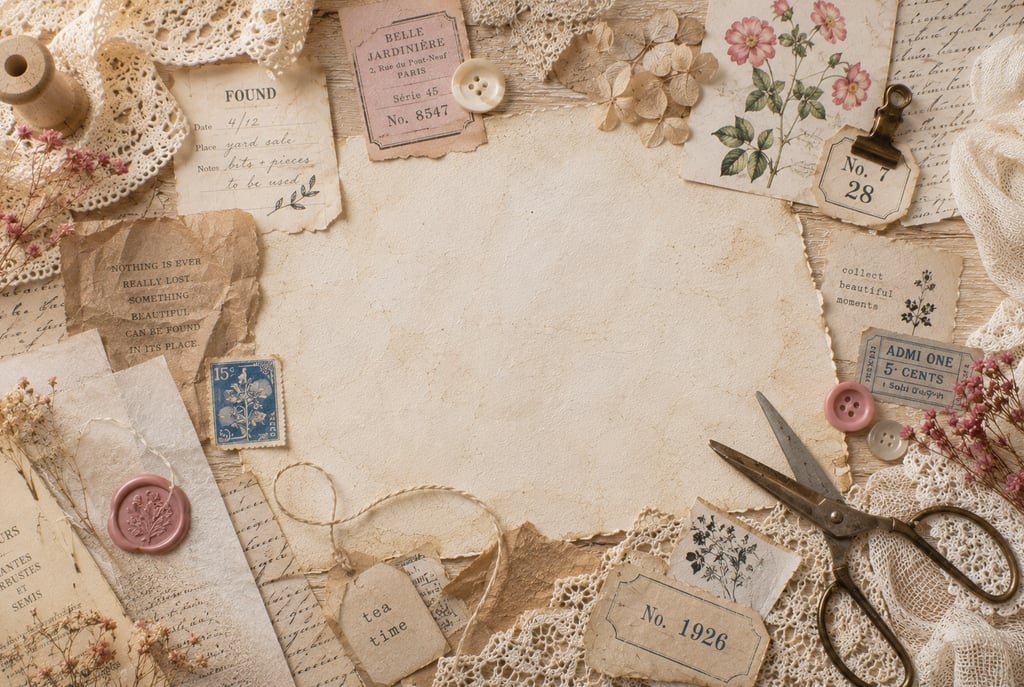
Trash can art now — real, actual, literal trash can art — is what we do. It is the art of taking what has been discarded or overlooked or used and finding within it something worth preserving. A cereal box becomes the cover boards of a handmade journal. A paper bag becomes a background wash, warm and crinkled and full of character. A tea bag, still faintly fragrant, becomes a tag. Cardboard packaging becomes structure. Tissue paper becomes translucent layering. Old envelopes become pockets. Newspaper becomes texture.
We are reaching into the trash bin — lovingly, purposefully, with genuine aesthetic intention — and making something beautiful out of what was going to be thrown away. We call it junk journaling. We call it recycling. We call it repurposing and upcycling and giving things a second life.
But you could also call it, with complete accuracy, the school of trash can art. And mean it as the highest compliment.
What the Trash Knows
There is something I find deeply moving about the materials we work with. A piece of aged paper carries history in it — not metaphorically, but literally. The discoloration along one edge is the story of where it sat. The slight brittleness is the story of how old it is. The faint printed text on the back is the story of what it was before it became what it is now.
When I layer that piece of paper into a journal page, I am not erasing that history. I am adding to it. The page becomes a palimpsest — a thing written over, added to, transformed, but still carrying the traces of everything it was before. The trash has a story. The junk has a past. And the journal holds all of it, every layer, every former life.
This is not what my grandmother would have called art, I think. It is too playful, too personal, too fond of things that serious art criticism tends to overlook. It doesn’t require a gallery. It doesn’t need a wall. It lives on a worktable and in a basket and between the pages of something you carry around in your bag.
But it is made with intention. With care. With a genuine desire to make something beautiful out of something that was heading for the bin. And if that isn’t art — or at least a very worthy cousin of it — I’m not sure what is.
What Grandma Helen Would Say Now
I think about this sometimes. She has been gone for many years now, and I keep a small portrait she painted of our family’s dog on the wall near my worktable. It is, objectively, a beautiful piece of work.
I wonder what she would make of junk journaling. I wonder if she would see it the way she saw the sponge sandwich — as something frivolous masquerading as something meaningful. Or if she would see it differently. If she would pick up a piece of aged paper and feel the weight of it and understand, the way artists understand things without being able to fully explain them, that there was something real happening here.
I like to think she’d come around. I like to think she’d sit at the table with me for a while, look at what I was doing, maybe reach for a piece of paper herself. I like to think she’d see that the intention behind it — the desire to make something beautiful, to slow down, to handle materials with care, to create something that didn’t exist before you sat down — is not so different from what she did her whole life.
And maybe she’d even concede, quietly, that Warhol had a point.
Probably not the sponge sandwich, though. Some things are a bridge too far.
The materials in my kits are curated with exactly this philosophy in mind — that beautiful things can be made from humble origins, that the aged and the worn and the slightly imperfect carry more character than the pristine, and that making something by hand out of something found is one of the oldest and most human forms of art there is.
Browse the current collections at starphoenixstudio.com. And if you have a Grandma Helen story of your own — someone who shaped how you think about making things, for better or for richer — I’d love to hear it.
With warmth,
Sandy