Begin your collection with 15% off your first publication — Use code: WELCOME15
The Man Who Painted Feeling
What Claude Monet Taught Me About Making Art from the Heart
CREATIVE LIFE & MINDSET
Sandy Lowdermilk
7/15/20267 min read
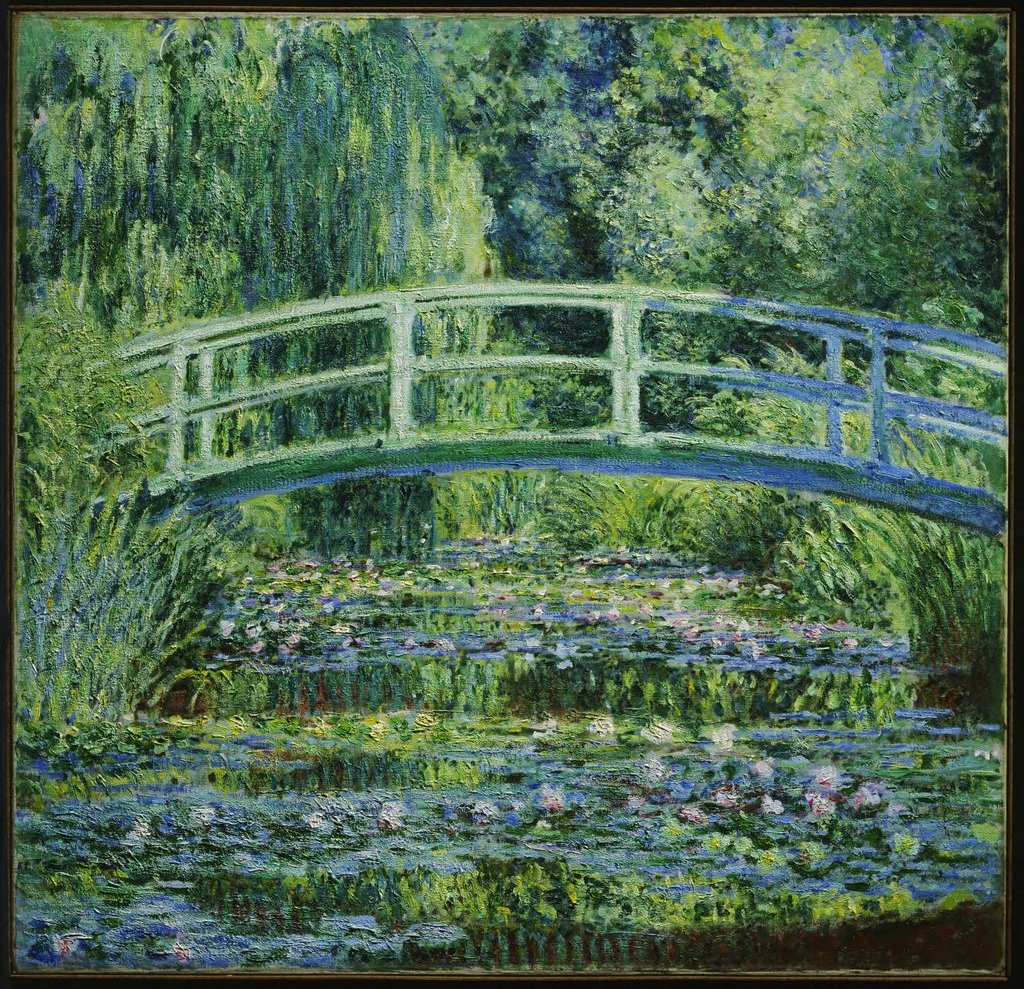
There is a garden in Normandy, France that changed the history of art.
It wasn't a grand gallery or a prestigious academy. It wasn't a wealthy patron's estate or a government commission. It was one man's personal paradise — a riot of color and water and light that he designed, planted, tended, and then spent the rest of his life trying to capture on canvas.
The man was Claude Monet. The garden was Giverny. And what he created there — both in the soil and on the canvas — is one of the most profound love letters to beauty that any human being has ever written.
I've loved Monet for as long as I can remember. Not just his paintings — though those stop my heart every single time — but his story. Because Monet's story isn't really about genius or fame or the Impressionist movement that changed art forever.
It's about a person who refused, absolutely refused, to stop seeing the world as beautiful.
And that, my friend, is something I think about every single time I sit down to design.
The Boy Who Saw Differently
Claude Monet was born in Paris in 1840 and grew up in Normandy on the coast of France, where the light does something extraordinary — it shifts and shimmers and changes its mind constantly, the way light near water always does.
From the beginning, Monet saw the world differently than other people. Not wrong. Not broken. Just differently. Where others saw objects — a haystack, a cathedral, a lily pad — Monet saw light. He saw the way morning fell across stone differently than afternoon did. He saw color where others saw shadow. He saw movement where others saw stillness.
His early teachers didn't always know what to make of him. The French Academy of Fine Arts — the establishment, the gatekeepers of "proper" art — rejected his work. Twice. The Paris Salon, the most prestigious exhibition in the art world, turned him away.
Can you imagine? Looking at a Monet and saying no thank you.
But here's what I love about young Monet: he didn't shrink. He didn't sand down his vision to fit someone else's definition of what art should look like. He gathered his equally rebellious friends — Renoir, Degas, Pissarro, Cézanne — and in 1874 they held their own exhibition. An independent one. On their own terms.
The critics were not kind. One of them, intending to mock Monet's painting Impression, Sunrise, used the word "Impressionist" as an insult.
Monet and his friends adopted it as a badge of honor.
Sometimes the thing someone says to diminish you becomes the very thing that defines you.
A Life of Beautiful Struggle
I want to be honest with you about something, because I think it matters: Monet's life was not a smooth, charmed ascent to greatness. It was difficult in ways that would have broken a lesser spirit.
He knew profound poverty — there were years when he couldn't afford paint, when he begged friends for money, when he worried about feeding his children. He lost his first wife, Camille, to illness at just thirty two years old, and he grieved her in the most devastating way imaginable — by painting her on her deathbed, his artist's eye refusing to stop even in his deepest heartbreak.
He struggled with self-doubt so severe that he destroyed hundreds of his own paintings. Hundreds. Works we would today consider masterpieces, gone because Monet looked at them and saw only failure.
He battled depression. He battled grief. He battled the creeping, terrifying loss of his eyesight in his final years — cataracts slowly stealing the very thing his entire life had been built around.
And yet.
And yet.
He kept painting. Through the poverty and the grief and the self-doubt and the failing eyes, he kept showing up to the canvas. He kept trying to capture the light. He kept planting flowers in his garden at Giverny and watching the way the water lilies floated on the surface of his pond and thinking — I have to paint that. I have to find a way.
The Water Lilies series — those enormous, dreamy, endlessly beautiful paintings that now live in their own dedicated rooms in museums around the world — were painted largely when Monet could barely see. He worked from memory and muscle and pure, stubborn love of beauty.
He was in his eighties. Nearly blind. And he was still creating.
That is a Phoenix story.
What Giverny Teaches Us About Creating
In 1883, Monet rented a farmhouse in a small village called Giverny, about forty five miles from Paris. He would live there for the rest of his life — forty three years.
From the beginning, the garden was as much a creative project as the paintings. Monet designed every inch of it with the same intentionality he brought to his canvas. He knew exactly which colors he wanted blooming in which season, which climbing roses would cascade over which archway, how the light would fall on the water garden he eventually built by diverting a nearby stream.
He wasn't just painting the garden. He was making the thing he wanted to paint. He was curating beauty so that he could then recreate it.
I find this extraordinary. And deeply familiar.
Because isn't that exactly what we do at our craft tables?
We gather our papers and our ephemera and our ribbons and our tags. We arrange and rearrange. We audition colors against each other. We move the vintage postcard three times before we find the angle where it belongs. We are not just making a journal page — we are making the garden first.
We are all, in our own way, designing Giverny.
The Impressionist in All of Us
Here is the thing about Impressionism that I don't think gets said enough:
It was radical not because of the brushstrokes or the color palette or the plein air technique. It was radical because it said — the feeling of a thing matters more than the precise depiction of it.
Monet wasn't trying to paint a haystack. He was trying to paint what it felt like to see a haystack in the golden light of a winter afternoon. He wasn't trying to paint Rouen Cathedral. He was trying to paint the way stone absorbs and releases light differently at six in the morning than at noon.
He was painting experience. Sensation. Feeling.
And I believe — I truly believe — that this is exactly what draws so many of us to junk journaling and paper art.
We are not trying to make perfect pages. We are trying to capture a feeling. The warmth of a Sunday afternoon. The nostalgia of something half-remembered. The romance of a world slightly softer and more beautiful than the one outside our windows.
When you layer a piece of vintage sheet music beneath a torn scrap of floral paper and press a weathered tag on top and ink the edges gold — you are not making a craft project.
You are making an impression.
You are doing exactly what Monet did.
His Eyes Failed. He Painted Anyway.
I want to come back to this because I think it's the most important part of Monet's story — and the most relevant to every one of us who has ever looked at our creative work and thought I'm not good enough. I can't do this. Why do I even try.
In 1912, Monet was diagnosed with cataracts in both eyes. For a painter — for a man whose entire life's work depended on his ability to see color and light with extraordinary precision — this was devastating. His vision blurred. Colors shifted and muddied. The crisp edges of the world he had spent seventy years painting dissolved into fog.
He considered stopping. He wrote to friends about his despair. He questioned everything.
And then he picked up his brush and kept going.
The paintings from his final years are different from his earlier work — looser, more abstract, the colors sometimes strange and turbulent in ways that puzzled people at the time. We now understand that we were seeing the world literally as Monet saw it through his failing eyes — and it is breathtaking.
His limitation became his final, greatest style.
After surgery partially restored his vision in 1923, he was horrified by some of what he had painted and destroyed canvases again. But he also kept the ones he loved. And he spent his last years working on the enormous Water Lilies panels that he donated to the French state — his gift to the world, painted almost blind, completed just before his death in 1926 at the age of eighty six.
Eighty six.
Still creating. Still reaching for the light.
What Monet Means to Me — And What He Can Mean to You
When I sit down to design a new collection for Star Phoenix Studio, I think about Monet more than I think about almost any other artist.
I think about his garden — the way he curated beauty deliberately and lovingly so that he would always have something magnificent to work from. That's what I try to do with every kit I design. I want to hand you a garden. I want the colors and the papers and the ephemera pieces to belong together so naturally that when you sit down at your craft table, the beauty is already there waiting for you. All you have to do is arrange it.
I think about his persistence — the way he kept showing up to the canvas even when his eyes were failing, even when his heart was broken, even when the critics were unkind. Creating is an act of courage. Every single time. And I have the deepest respect for every person who sits down at their craft table and makes something, regardless of whether they think they're "good enough."
You are good enough. Monet was rejected by the Paris Salon. Twice.
And I think about his philosophy — that the feeling of a thing matters more than the precise depiction of it. Your journal pages don't have to be perfect. They have to be felt. Layered with intention and love and the specific, personal aesthetic that is entirely your own.
That is Impressionism. That is junk journaling. That, I believe with my whole heart, is art.
Your Giverny Is Waiting
Monet built his garden so he would always have beauty to come back to.
I'd like to suggest that your craft table is your Giverny. The place you come to when the world feels too loud and too sharp and too fast. The place where you slow down and feel the paper between your fingers and lose track of time in the most wonderful way.
And just as Monet filled his garden with the colors and flowers that spoke most deeply to him, I designed the collections at Star Phoenix Studio to help you fill your creative space with beauty that feels intentional, coordinated, and completely, uniquely yours.
Whether you're drawn to the dreamy romance of Shabby Chic, the wild freshness of Spring Flowers, or the wandering wonder of Butterfly & Nature — there is a garden here with your name on it.
Come in. Pick up your scissors. The light is perfect right now.
Inspired by Monet? Save this post to your Pinterest boards and share it with a fellow art lover. And if you'd like a free printable page to start your own creative garden, join the Star Phoenix Studio newsletter — I'd love to welcome you.
With warmth,
Sandy