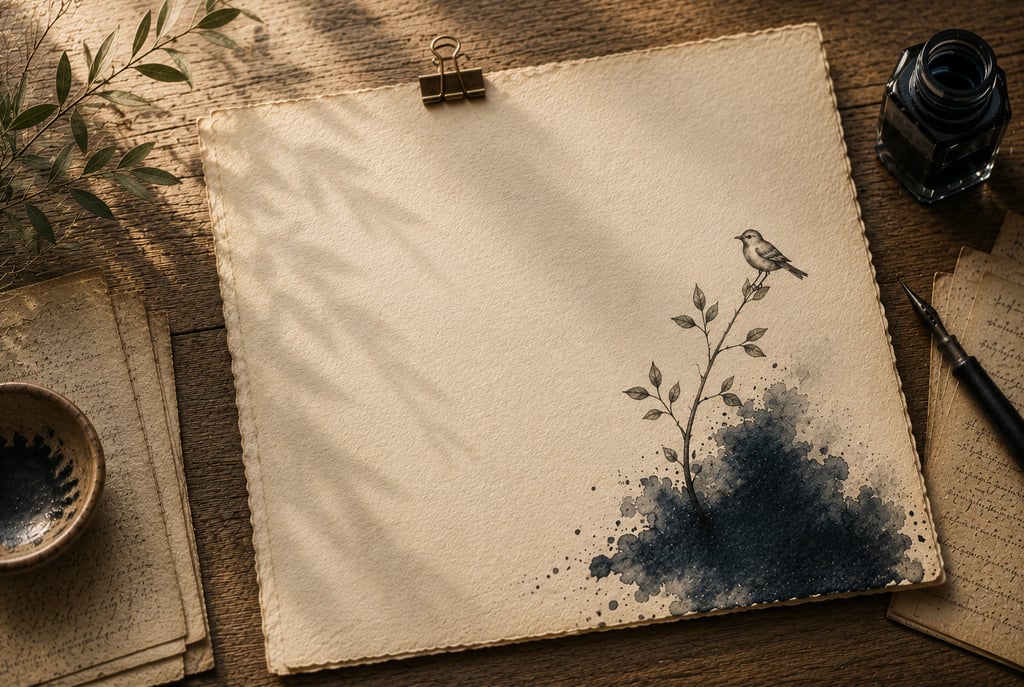
It was a perfectly good piece of paper. Aged, creamy, with that particular warmth that only comes from something that has lived a little. I had a plan for it. I knew exactly where it was going.
And then I knocked over the ink.
Not a little ink. A real, committed, no-going-back spill. A dark bloom spreading across the lower right corner of a page I had been nursing for twenty minutes. I sat there and looked at it. The page looked back.
I almost reached for the trash bin. I almost started over.
Instead, I picked up a fine-tipped pen, leaned in close, and drew a single thin branch growing out of the edge of the spill. Then a few small leaves. Then, because I couldn't stop myself, a tiny bird perched at the end of the branch, surveying the dark pool below as though it had always been a pond.
It became the best thing on the page. Possibly the best thing I made that month.
The Disaster That Wasn't
Here's what I've come to believe after years of making things: the moment you decide a mistake is a disaster is the moment it becomes one. Up until that decision, it's just an unexpected element. It's the raw material of something you hadn't planned yet.
The ink spill didn't ruin the page. My first reaction — the one that wanted to throw it away — almost did.
There's a pause that happens in those first few seconds after something goes wrong. A breath. A beat of silence between the accident and your response to it. That pause is where everything gets decided. In that pause, you can choose to be someone whose page is ruined, or someone who just got handed an interesting problem.
I try, as often as I can remember to, to choose the interesting problem.
The Torn Edge
It doesn't have to be ink. Accidents come in all forms, and they are reliably inconvenient.
I was trimming a piece of delicate tissue paper once — the kind that tears if you look at it too directly — and it tore. Not along the line I intended. Diagonally, raggedly, in exactly the wrong direction. I had needed a clean rectangle and instead I had two irregular pieces that didn't add up to anything useful.
I almost set them aside. Almost.
But I held them up to the page instead, one slightly overlapping the other, and something happened. The torn edges — those imperfect, unplanned, feathery edges — were the most beautiful thing about them. They caught the light differently than a cut edge ever would. They looked aged. Authentic. Like something that had been found rather than made.
Now I tear paper on purpose. Deliberately. With great enthusiasm.
The scissors still have their place, but the torn edge taught me something a clean cut never could: that imperfection has a texture that perfection simply doesn't. Your eye knows the difference, even when your brain doesn't. The torn edge says real. It says time. It says this was handled by human hands. And in a junk journal, there is no higher compliment.
The Wrong Color
This one still makes me laugh.
I was deep into a spread built entirely around a palette of warm, dusty neutrals — the kind of palette I could live inside forever, all aged ivory and soft ochre and the particular gray-brown of old envelopes. I reached for what I was certain was a piece of muted blush paper. I glued it down. I stepped back.
It was not muted blush. It was a fairly assertive, unapologetic coral. It had apparently wandered in from an entirely different collection and made itself comfortable in the wrong pile, and now it was glued to my page and looking very pleased with itself.
My first instinct was to fix it. Cover it, remove it, bury it under layers until it couldn't be seen.
My second instinct — the better one — was to look at it for a while before doing anything at all.
So I looked. And after a few minutes, I noticed that the coral was doing something to the neutrals around it that nothing else on the page was doing. It was waking them up. It was the reason the ivory looked like ivory and not just pale. It was the reason the ochre had warmth. It was the one note in the chord that made all the other notes matter.
I left it. I built the rest of the spread around it. I added one small echo of it in the upper left corner — just a sliver, just enough — and the page resolved into something I couldn't have planned if I'd tried.
This is what I wrote about in The Magic of Neutral Palettes — that a neutral palette isn't quiet because everything in it is muted. It's quiet because everything in it is considered. Sometimes the most considered thing you can do is leave in the element that surprised you.
What the Accident Knows That You Don't
I have a theory about happy accidents, and it is this: your hands know things your planning brain doesn't.
The ink spills in a particular direction because of how you were holding the bottle, which is connected to how your body was positioned, which is connected to the mood you were in and the rhythm you were working at. The paper tears the way it tears because of the grain and the grain is part of the paper's history. The wrong color ended up in the wrong pile because somewhere in the back of your mind you were already tired of how safe everything felt.
Accidents are not random. They are the part of the process that bypasses your intentions and goes straight to your instincts.
Which is why, when something goes wrong on a page, I try to ask one question before I do anything else: What does this want to be?
Not: how do I fix this. Not: how do I get back to the plan. But: what does this element, this unexpected thing that just arrived uninvited, what does it want to become?
The answer is almost always more interesting than whatever I had originally intended.
Give Yourself Permission to Not Start Over
There is a particular kind of creative perfectionism that disguises itself as high standards. It looks like caring deeply about your work. It sounds like knowing what good looks like. But what it actually does, if you let it run unchecked, is convince you that the only acceptable response to an imperfect moment is to erase it and begin again.
Starting over has its place. I'm not suggesting you keep every page regardless of what happens to it. But I am suggesting that the bar for starting over is probably lower than it should be for most of us, most of the time.
The pages I love best — in my own work and in the work of others — are almost never the ones that went exactly according to plan. They're the ones where you can feel the process. Where something shifted partway through and the maker had to respond to it. Where the evidence of a decision, or a surprise, or an accident gracefully absorbed, is still visible in the finished thing.
That's not imperfection. That's presence. It's proof that a human being was here, making something, and that the making was a conversation rather than an execution.
The next time something goes wrong on your page, try sitting with it for just a moment before you reach for a solution. Let the accident show you what it came to do.
You might be surprised what it knows.
My kits are designed to give you beautiful, coordinated pieces to work with — but what you do with them, including the unexpected things, is entirely and wonderfully yours.
Browse the current collections at starphoenixstudio.com. And if a happy accident turns into something remarkable, please show me. Those are always my favorite messages to receive.
With warmth,
Sandy